Signs Your AC Compressor Overheated After a Power Surge
Signs Your AC Compressor Overheated After a Power Surge
Phoenix summers leave very little margin for electrical trouble. A single overnight outage, a monsoon-related utility interruption, or a sharp voltage spike after power returns can push an already stressed air conditioner into failure by sunrise. When the compressor overheats after a surge, the house usually tells the story fast. The system may hum but not start. It may trip the breaker, blow warm air from vents, or shut down again after a short run. In those moments, Phoenix homeowners usually stop searching for general answers and start looking for Emergency AC Repair that can respond the same day.
That urgency is not an overreaction in Phoenix, AZ. In Maricopa County, air conditioning is a health and safety system for infants, seniors, pets, and anyone in a house that climbed into the 90s overnight. In neighborhoods like Arcadia 85018, Biltmore and Camelback East 85016, Ahwatukee Foothills 85044, and Desert Ridge 85050, equipment often runs for long stretches under extreme thermal load before a storm ever arrives. Once a power surge hits, the compressor, which is the sealed motor-driven pump that moves refrigerant through the system, may already be operating near its limit. That is why Emergency AC Repair in Phoenix often starts with compressor-related symptoms after a summer outage.
Why surge damage hits Phoenix AC systems harder
Phoenix sits in ASHRAE climate zone 2B, a hot-dry desert climate with design cooling temperatures that generally fall between 110 and 117 degrees depending on location and elevation. At the equipment pad, especially on west-facing homes near South Mountain Park, Maryvale, and North Phoenix, afternoon surface temperatures around the condensing unit commonly reach 130 to 140 degrees in June and July. That matters because the outdoor unit contains the compressor, the run capacitor, and the contactor, which are all electrical or electromechanical parts that react badly to unstable voltage.
The run capacitor, which is the cylindrical electrical component inside the outdoor condensing unit that stores and releases the energy pulse needed to keep the compressor motor running smoothly, is one of the first parts checked after a surge. The contactor, which is the heavy-duty switch that opens and closes high-voltage power to the condenser, is another common casualty. When power drops and returns abruptly, either part can fail. If either one sticks, pits, swells, or reads outside its rated value on a capacitance meter, the compressor may overheat or lock out.
Phoenix monsoon season adds another layer. Haboob dust from June through September packs caliche fines into the condenser coil, which is the outdoor heat-rejecting coil wrapped around the condensing unit. A coil clogged with desert dust can reduce system capacity by roughly 15 to 25 percent until it is cleaned. That reduced heat transfer causes higher head pressure, which is the pressure the compressor works against while pumping refrigerant. If a power surge lands on a system already struggling with high head pressure, the compressor windings can overheat fast. Calls for Emergency AC Repair often come in after both problems stacked on the same day.
What an overheated compressor usually looks like after the power comes back
The most obvious sign is a house that never cools back down after the outage ends. The thermostat may call for cooling, the indoor blower may run, and air may move through the registers, but the air feels room temperature or warm. That points to an outdoor unit that never started correctly, or started and shut itself down under thermal overload protection. In Phoenix, that pattern is one of the clearest reasons to bring in Emergency AC Repair instead of waiting for a standard appointment.
Another common sign is a loud humming sound from the outdoor unit followed by silence. That hum often means the compressor is trying to start but cannot get past the inrush phase. Sometimes the run capacitor has failed. Sometimes the contactor is damaged. Sometimes the compressor itself has suffered internal winding damage from the surge. On a severe call, the breaker trips almost immediately when the condenser tries to start. That can indicate a short to ground, locked rotor condition, or compressor windings damaged enough to pull excessive amperage.
Short cycling is another warning. The condenser may come on for a few seconds, sound strained, and then shut off before stable cooling begins. That repeated start-stop pattern is dangerous because every failed start adds heat to the compressor. In Phoenix, where the outdoor cabinet may already be extremely hot near I-10 corridors and dense urban heat-island areas around Encanto and Central Phoenix, repeated restart attempts can turn a repairable electrical problem into full compressor failure.
There is also the smell factor. An overheated compressor or burned electrical component can produce a sharp hot-metal or burned varnish odor near the condenser. That smell comes from insulation breakdown on motor windings or scorched electrical contacts. If a technician opens the panel and finds a swollen capacitor, blackened contactor points, or melted wire insulation, the surge event becomes much easier to trace.
The symptoms that point to the compressor itself and not just a minor electrical part
Not every post-outage cooling failure means the compressor is destroyed. In fact, many Phoenix emergency calls end with a failed capacitor, damaged contactor, or tripped disconnect rather than a condemned compressor. The distinction matters because compressor replacement is a major repair. Still, certain signs push the diagnosis toward actual compressor overheating.
The first is high amp draw with no proper startup. A technician tests that with an amp clamp while checking rated load values against the equipment nameplate. If the compressor draws locked-rotor amperage and never stabilizes, that suggests it is mechanically seized or electrically damaged. The second is grounded windings. That test uses a meter to verify whether the compressor windings have shorted to the compressor shell. If they have, the compressor is done. The third is repeated thermal overload reset behavior. Some compressors cool off, restart later, then fail again under load. That pattern usually means the internal motor is overheating because it can no longer operate normally.
Low refrigerant charge can complicate the picture. A system that lost charge through a leak at the evaporator coil or TXV valve connection may run hot even before a surge. The surge becomes the event that exposes an existing weakness. That is why proper Emergency AC Repair in Phoenix is diagnostic work first, not parts-swapping. Refrigerant charge must be verified using superheat and subcooling readings, which are field measurements that confirm whether the system contains and meters refrigerant correctly.
What Phoenix technicians actually inspect on a surge-related no-cooling call
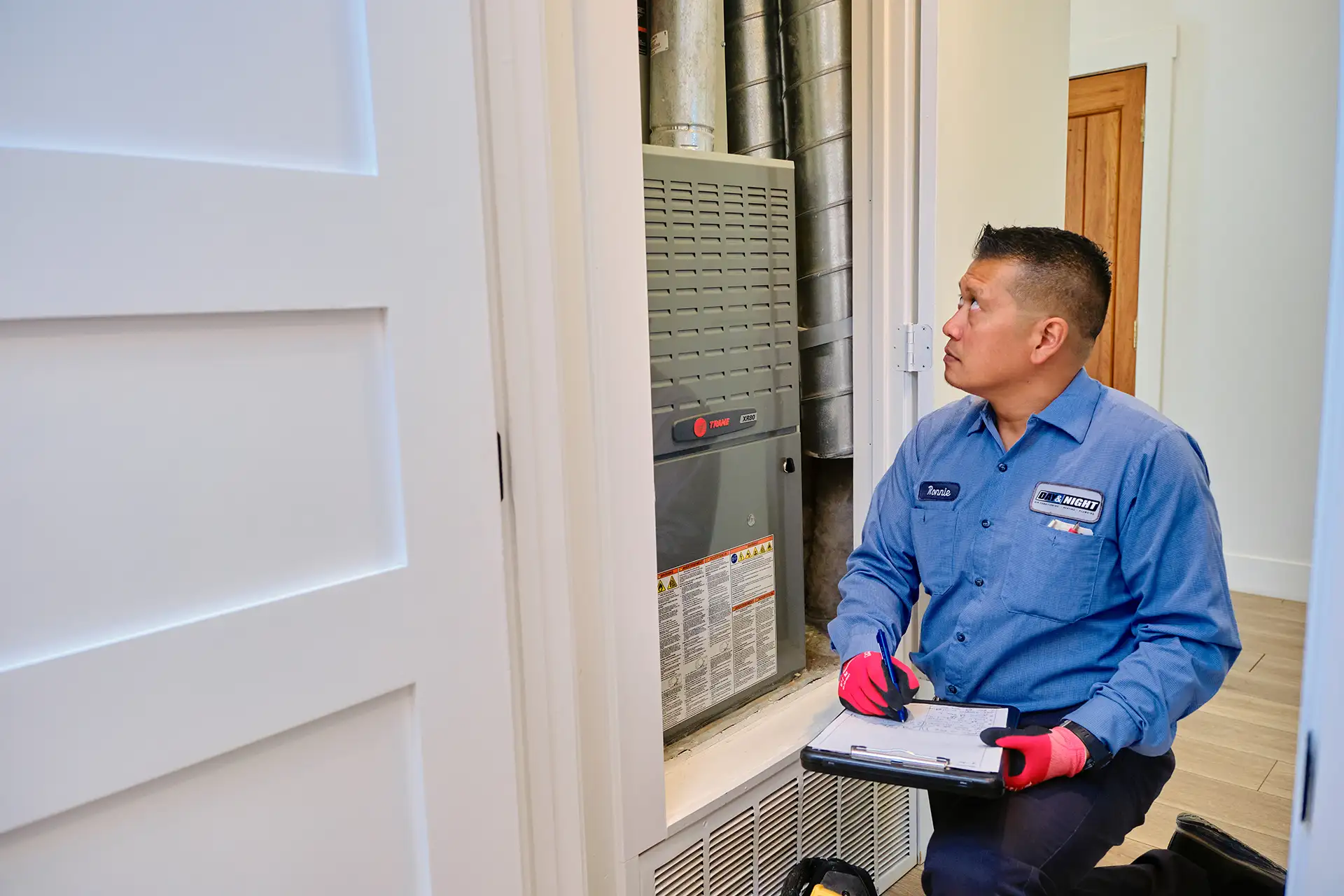
A serious no-cooling call in Phoenix should never be reduced to a quick glance and a guess. Day & Night Air Conditioning, Heating & Plumbing approaches this type of call as a full electrical and refrigeration diagnostic because surge damage often affects more than one component. On many systems, the visible failed part is only the first problem found.
The thermostat is checked first to confirm cooling demand and control voltage. Then the disconnect, breaker, wire integrity, and contactor are inspected for obvious voltage damage. The run capacitor is tested with a capacitance meter, not judged by appearance alone, because some bad capacitors look normal while reading far below their rated microfarad value. If the compressor attempts to start, amp draw is measured. If the condenser runs, refrigerant pressures and temperature splits are checked to determine whether the compressor is actually pumping and whether the condenser coil is rejecting heat properly.
Coil condition matters a great deal in Phoenix. A surge call in Sunnyslope 85020 or along Loop 202 in Ahwatukee may reveal a compressor that survived the voltage event but is operating under severe stress because the condenser coil is packed with fine dust. That can mimic deeper failure. In these cases, proper cleaning can restore airflow across the coil and lower operating pressure enough to prevent repeat overheating.
Technicians also inspect the air filter, blower operation, and evaporator coil condition. Poor indoor airflow can cause the evaporator to freeze, which changes refrigerant behavior and can lead to erratic compressor operation after restart. The air filter, whether MERV 8, MERV 11, or MERV 13, affects airflow resistance. A higher MERV filter can trap smaller particles, but if the duct system is already restrictive, too much filter resistance can contribute to low airflow and coil icing.
Why a power surge can expose an AC system that was already near the end
Phoenix has a large housing stock from the 1950s through the 1980s, especially in Arcadia, Camelback East, and parts of North Central Phoenix. Many of those homes have older ductwork, aging insulation values, west-facing glass, and equipment that has run through years of extreme summer load. Some condensers were originally sized by square footage instead of a Manual J Residential Load Calculation under ACCA Standard 1. That matters because rule-of-thumb sizing often misses solar gain, infiltration, and actual envelope conditions.
An undersized unit can run almost continuously during 115-degree weather. An oversized unit can short cycle, fail to control humidity during monsoon season, and wear out the compressor through repeated starts. Both situations increase compressor stress. When a surge happens, the homeowner sees a sudden failure, but the equipment may have been operating on borrowed time for several seasons. That is one reason Emergency AC Repair visits in Phoenix often become repair-versus-replacement discussions, especially on older R-410A systems installed a decade or more ago.
The 2026 refrigerant transition changes that decision path. New R-410A system manufacturing ended January 1, 2026 under the EPA SNAP framework, and new equipment now moves to refrigerant R-454B, an A2L mildly flammable refrigerant with a global warming potential of 466 compared with R-410A at 2,088. Existing R-410A systems can still be serviced, but supply dynamics will tighten over time. For a compressor-damaged legacy unit that is already aging, Phoenix homeowners often weigh repair cost against installing equipment built around the current standard. That is especially true when the system also has poor duct performance, coil fouling history, or chronic high utility bills.
A shareable Phoenix fact that changes how surge calls are understood
One of the least appreciated realities in Phoenix cooling is that the outdoor condenser may be trying to start after a utility interruption while sitting in pad-level conditions that are far hotter than the official air temperature. On west-exposure installations across Maricopa County, the cabinet environment around the condensing unit commonly reaches 130 to 140 degrees in peak summer afternoons. That makes Phoenix run capacitor failure rates disproportionately high in June and July compared with moderate-climate markets. Add a sudden voltage disturbance from monsoon weather and the compressor startup event becomes much harsher than most homeowners realize.
That local condition is important because it explains why two homes with the same brand, same age, and same thermostat setting can behave very differently after a storm. A shaded condenser near Paradise Valley Village may recover. A full-sun condenser beside a block wall in South Phoenix may not. The difference is thermal stress before the surge ever occurs. It also explains why searching for Emergency AC Repair after a power event in Phoenix is so common during monsoon months.
How repairable compressor-overheat cases differ from replacement cases
Some surge calls end well. If the compressor survived and the failed part is the run capacitor or contactor, the system can often be restored the same day once electrical values are confirmed and the unit is tested under load. If the condenser coil also needs cleaning and the refrigerant charge checks out, the repair may hold reliably. Those are the cases where prompt Emergency AC Repair prevents a deeper failure.
Other cases are more serious. If the compressor windings are damaged, if the unit repeatedly goes off on thermal overload, or if the system is an older R-410A unit with multiple pending issues, repair may no longer make financial sense. A compressor replacement on an aging condenser can still leave the homeowner with an old coil, old fan motor, older controls, and declining refrigerant economics. In Phoenix, that matters because the cooling season is long and unforgiving. Reliability matters more here than it does in a milder market.
There are also edge cases. Some systems restart temporarily after cooling off, which makes the homeowner think the problem passed. Then the compressor fails again the next afternoon. That intermittent pattern is common enough in Phoenix that it should not be ignored. A system that recovered once after a surge may still need Emergency AC Repair because damaged electrical parts can drift further out of tolerance under repeated heat load.
Neighborhood patterns matter more than most people expect
Phoenix is not one uniform equipment environment. Mid-century homes in Biltmore and Arcadia often have older ducts, tighter side-yard condenser placements, and aging service panels that can complicate electrical events. Newer homes in Desert Ridge and parts of Ahwatukee may have better envelope performance but still place condensers in harsh sun exposures near masonry walls that trap radiant heat. Homes near Phoenix Sky Harbor Airport and major corridors like I-17 or Loop 101 can deal with extra dust loading. Those local differences shape how a surge-damaged system presents and how quickly the compressor overheats afterward.
Day & Night Air Conditioning, Heating & Plumbing has worked these patterns since 1978 from its Phoenix headquarters at 3669 E La Salle St in 85040. That long local history matters on emergency calls because technicians who work the Valley every day know how often no-cooling complaints in 85016, 85018, 85044, and 85048 tie back to a combination of heat stress, dust load, and unstable power rather than one isolated mechanical defect. That kind of field judgment is what people expect when they call for Emergency AC Repair instead of a general service window several days later.
What separates a serious emergency diagnosis from a shallow one
A shallow diagnosis stops when the system turns back on. A serious diagnosis confirms why it failed, what electrical values the key components now show, whether the compressor is drawing normal amperage, and whether the refrigerant circuit is behaving within expected range. It also looks at the conditions that pushed the unit toward failure in the first place. In Phoenix, that means checking condenser cleanliness, airflow, filter restriction, thermostat accuracy, and overall equipment age.
That broader view is especially important now that the market is transitioning into R-454B equipment. Technicians need current training to work safely around the 2026 refrigerant standard and to explain what still makes sense for legacy R-410A systems. Day & Night Air Conditioning, Heating & Plumbing fields EPA Section 608 certified technicians with R-454B transition training, and the company holds Arizona ROC C-39 air conditioning and refrigeration licensure and Arizona ROC C-37 plumbing licensure. On the cooling side, those credentials matter when a homeowner needs a real answer on whether the compressor is salvageable or whether the system has crossed into replacement territory.
For some homes, the call also exposes broader issues. A surge event may reveal a weak thermostat, a clogged condensate drain line that tripped a float switch, or duct leakage severe enough to make the system appear weaker than it is. In older Phoenix ranch homes, original duct systems can leak large amounts of conditioned air into the attic. That can make a repaired condenser seem underpowered when the real issue is air loss before the supply reaches the rooms.
When emergency repair becomes the bridge to replacement
Emergency calls do not always end with replacement, and they should not start there. Still, in Phoenix, a compressor overheating after a surge can become the moment when replacement becomes the more stable path. If the unit is older, refrigerant costs are rising, and the system was already fighting sizing or duct issues, replacement can reduce repeat breakdown risk during the longest cooling months.
For homeowners who move into that decision path, current Phoenix installation standards matter. New systems should meet the Southwest minimum of 14.3 SEER2 and 11.7 EER2 for split systems under 45,000 BTU, and proper sizing should be based on Manual J, followed by Manual S equipment selection and Manual D duct design where duct modifications are needed. In APS https://home-blogger.s3.us.cloud-object-storage.appdomain.cloud/ac-repair-near-me-in-maricopa-county-2026.html and SRP service areas, qualifying high-efficiency equipment may also tie into available rebate programs, including APS Cool Rewards heat pump rebates up to $2,000 and SRP HVAC rebates up to $1,500, with federal Section 25C tax credits potentially adding more on qualifying heat pump installs. Those incentives matter only if replacement is actually justified, but they are part of the real Phoenix repair discussion in 2026.
Even then, surge-related repair remains the first question. Many homeowners who search for Emergency AC Repair simply need a failed electrical component replaced and the system tested correctly. The problem is that no one knows which category the call falls into until the compressor, capacitor, contactor, and refrigerant circuit are all checked under actual operating conditions.
What homeowners tend to notice first during a compressor-overheat event
-
The outdoor unit hums or clicks but the house does not cool.
-
The breaker trips after the storm or after power returns.
-
Air still comes from the vents, but it feels warm or only slightly cool.
-
The condenser starts and stops every few seconds.
-
A hot electrical smell appears near the outdoor unit.
What technicians usually need to confirm before calling the compressor failed
-
Capacitor value tested against rating with a capacitance meter.
-
Contactor condition, voltage delivery, and wire integrity.
-
Compressor amperage and winding condition.
-
Refrigerant charge verified through pressure and temperature readings.
-
Condenser coil and airflow conditions that may be driving high pressure.
Why local trust signals matter on a true no-cooling emergency
On a July morning in Phoenix, the quality of HVAC company in Maricopa County AZ the diagnosis matters as much as response time. A household near Camelback Mountain or in Ahwatukee East 85048 may have only a short window before indoor temperatures become difficult for children, elderly residents, or pets. That is why people looking for Emergency AC Repair usually focus on real dispatch capacity, local experience, and a company that gives a written flat-rate price before the work starts. On after-hours calls, uncertainty about pricing adds stress that the homeowner does not need.
Day & Night Air Conditioning, Heating & Plumbing has served Phoenix and Maricopa County since 1978 and operates with integrated HVAC and plumbing capability across the Valley. The company’s recent growth, including the March 2026 addition of Armstrong Plumbing and the 2025 to 2026 partnerships with Bry A/C and A Desert Oasis, expanded capacity across the market without changing the local-service model. For cooling calls, that means 24/7 availability, same-day service for urgent breakdowns, and technicians who work Phoenix heat conditions every day rather than treating this climate like any other city.
There is also the social proof side. In emergency service, reputation matters because the customer is often making a fast decision under pressure. Day & Night Air Conditioning, Heating & Plumbing carries a 4.9 star Google rating across more than 9,400 verified reviews, plus Google Guaranteed and BBB A+ accreditation. Those signals matter because a compressor-overheat call is rarely a casual service visit. It is an urgent problem with expensive consequences if the diagnosis is wrong.
When Phoenix residents need immediate action
If the system stopped cooling after an outage, if the breaker keeps tripping, if the outdoor unit hums but will not start, or if the compressor seems to be shutting off from heat, that is the point where Emergency AC Repair becomes the correct service category. Day & Night Air Conditioning, Heating & Plumbing provides 24/7 emergency response across Phoenix and Maricopa County, including Arcadia, Biltmore, Ahwatukee, Desert Ridge, North Phoenix, Maryvale, Sunnyslope, and surrounding areas along I-10, I-17, Loop 101, and Loop 202. The company has served the Valley since 1978 from 3669 E La Salle St in 85040, holds Arizona ROC C-39 HVAC and ROC C-37 plumbing licenses, and staffs EPA Section 608 certified technicians with current R-454B transition training. Upfront flat-rate pricing is presented before repair work begins. For urgent cooling failure, call Day & Night Air Conditioning, Heating & Plumbing at (602) 492-9656 to schedule Emergency AC Repair in Phoenix.
Phoenix, AZ 85040